


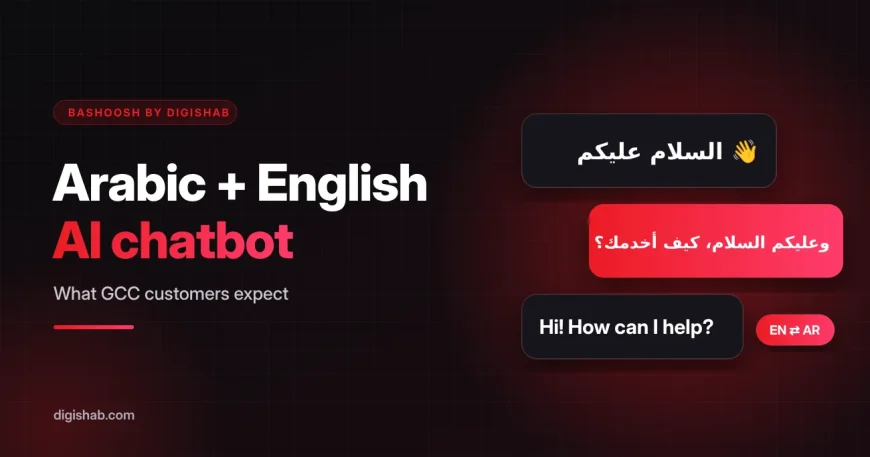
In the Gulf, one customer may write “Hi, how much is the package?” and the next may write “السلام عليكم، كم سعر الباقة؟”. Some customers even mix both languages in one message. If your chatbot only understands one of them, you lose half your audience.
This guide explains what customers in Saudi Arabia, the UAE and the wider GCC expect from a bilingual chatbot, the mistakes that make them leave, and how to choose an AI agent that speaks to them properly.
Why Bilingual Matters So Much in the Gulf
The GCC is one of the most mixed markets in the world. Locals often prefer Arabic, especially in Saudi Arabia. Expats from many countries use English. Many people switch between the two depending on the topic.
- Saudi customers often start in Arabic, even on English websites
- Emiratis may write in English at work and Arabic in the evening
- Expats from South Asia, Europe and the Philippines usually write in English
- Many customers mix Arabic and English, sometimes using Arabizi
A chatbot that answers an Arabic question in English, or replies with stiff textbook Arabic, feels foreign. Customers notice immediately.
What Customers Expect From an Arabic Chatbot
- Reply in my language. If I write in Arabic, answer in Arabic. If I switch, switch with me.
- Sound natural. Use friendly, clear Arabic, not machine translation.
- Understand local words. Know Gulf terms for areas, services and everyday phrases.
- Be polite. Greetings matter. A reply to “السلام عليكم” should start with “وعليكم السلام”.
- Be quick and clear. Give the answer first, then the details.
Common Mistakes That Lose Arabic-Speaking Customers
- Answering every message in English
- Translating English word by word into broken Arabic
- Showing Arabic text in the wrong direction or with broken letters
- Ignoring greetings and jumping straight to sales
- Giving long, formal replies to a simple question
- Not understanding mixed Arabic-English messages
Each of these makes the customer feel the business doesn’t really serve people like them.
How Bashoosh Handles Arabic and English
Bashoosh, DigiShab’s AI agent, was built for the GCC from the start:
- Replies in English or Arabic, matching the customer
- Learns from your own website content in both languages
- Answers only from content you approve
- Collects leads and sends them to your team on WhatsApp
- Works on your website and on WhatsApp
If you have a separate Arabic website page, Bashoosh can use it so answers stay accurate in both languages. Try it in the live demo by writing in Arabic, then switching to English.
Bashoosh by DigiShab
Answer every enquiry in seconds, 24/7
Bashoosh is your AI receptionist, sales assistant and customer support in one chat. It answers website and WhatsApp enquiries in English and Arabic, captures leads and alerts your team instantly.
Tone and Respect Matter as Much as Language
In Gulf culture, how you say something matters. Customers expect warmth and respect, even in a short chat. A good bilingual AI agent should:
- Return greetings properly before answering
- Use polite, friendly phrases instead of cold, robotic sentences
- Keep answers short and clear, especially on mobile
- Avoid slang that may feel too casual for a professional business
- Know when to hand over to a person, such as complaints or sensitive topics
These small details make customers feel they are talking to a local business that understands them, not a foreign tool.
Industries Where Bilingual Chat Makes the Biggest Difference
- Healthcare and aesthetics: patients often prefer to ask sensitive questions in their own language
- Legal and PRO services: visa and company setup questions are detailed and easier in the customer’s first language
- Real estate: local buyers and expat tenants expect answers in their language
- Education and training: parents and students switch between Arabic and English
- Events and sports: large, mixed audiences ask the same questions in both languages
In each of these, a chatbot that speaks only English quietly turns away a large share of potential customers.
How to Test a Bilingual Chatbot Before You Buy
- Ask the same question in English and then in Arabic, and compare the answers.
- Write a greeting like “السلام عليكم” and see how it replies.
- Mix both languages in one message.
- Ask something that is not on your website and check that it admits it doesn’t know.
- Ask for a human and see how quickly it hands over.
- Test it on WhatsApp and on your website, on a mobile phone.
You can run all of these tests in the Bashoosh live demo in a few minutes.
Bilingual Chat and SEO Go Together
A bilingual chatbot works best when your website itself speaks both languages. Separate Arabic pages help Google show your business to people searching in Arabic, and they give the AI accurate content to answer from. When customers find you in Arabic on Google and then get a natural Arabic reply in chat, the experience feels consistent from the first search to the first conversation, and trust builds much faster.
Make Your Website Ready for Bilingual AI
An AI agent is only as good as the content it learns from. Before you launch, check:
- Your main services have clear pages, ideally in both English and Arabic.
- Prices, timings and locations are up to date.
- Your FAQ answers the top questions customers ask.
- Your Arabic pages are separate pages, which is also better for Arabic SEO.
DigiShab can help with both: building proper Arabic pages and setting up the AI agent that answers from them.
Talk to DigiShab
Want Bashoosh answering your customers 24/7?
Tell us about your business and our team will show you how Bashoosh fits, in English or Arabic.
Frequently Asked Questions
Can an AI chatbot reply in Gulf Arabic?
Bashoosh replies in clear, natural Arabic that customers in the Gulf understand, and switches to English when the customer does.
Does the chatbot understand mixed Arabic and English?
Yes. Customers can write in either language or mix them, and Bashoosh replies naturally.
Do I need an Arabic website for an Arabic chatbot?
It helps a lot. Separate Arabic pages give the AI accurate content and also improve your Arabic SEO.
Does it work on WhatsApp?
Yes. Bashoosh works on your website and WhatsApp.
Which countries is it for?
Saudi Arabia, the UAE, Qatar, Kuwait, Oman, Bahrain and any business with Arabic- and English-speaking customers.

